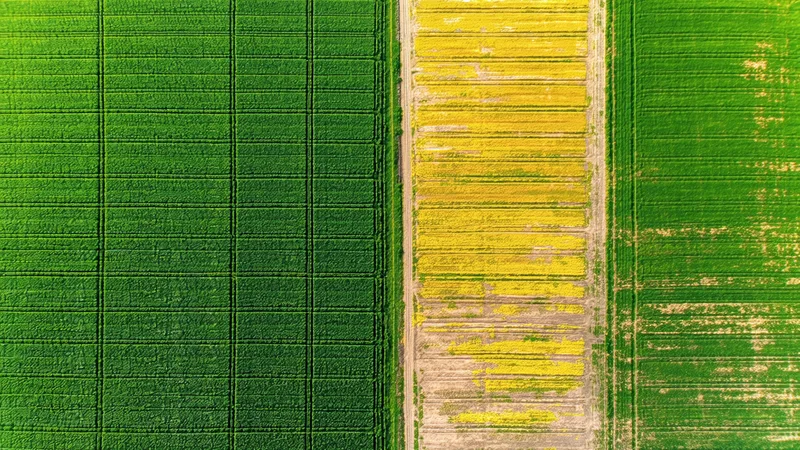
The choice between Sentinel-2 and Landsat for crop monitoring is often framed as a resolution question: 10 meters versus 30 meters. That framing undersells the real issue. For commodity-scale crop area estimates, the difference is academic. For field-polygon-level insurance underwriting, where you need to delineate and price individual 80-acre parcels with reliable NDVI time-series, 30-meter resolution produces systematic errors that compound at scale. This article walks through where each sensor system performs well, where each fails, and what that means for practitioners building operational crop monitoring products.
The Sensor Architectures: What You're Actually Working With
Sentinel-2 is a twin-satellite constellation operated by the European Space Agency under the Copernicus program. The two satellites — Sentinel-2A and Sentinel-2B — orbit at 10-day revisit each, producing an effective 5-day revisit at mid-latitudes when both are operational. The MultiSpectral Instrument (MSI) captures 13 spectral bands: four bands at 10-meter resolution (Blue, Green, Red, NIR), six bands at 20-meter resolution (Red-Edge 1/2/3, Narrow NIR, SWIR 1/2), and three atmospheric correction bands at 60 meters. For agricultural applications, the 10-meter visible/NIR bands are the primary data product, with the 20-meter Red-Edge and SWIR bands providing supplementary crop stress and moisture information.
Landsat is a joint USGS/NASA program now on its ninth satellite generation. Landsat 8 and Landsat 9 together provide an 8-day revisit at 30-meter resolution. The Operational Land Imager (OLI) captures coastal/aerosol, blue, green, red, NIR, SWIR1, and SWIR2 bands — all at 30 meters. The thermal band (TIRS) is 100 meters. Crucially, Landsat's free data archive goes back to 1972 (with varying quality), providing a historical depth that Sentinel-2 (launched 2015) cannot match for long-term trend analysis.
Field Delineation: Where 10 Meters Versus 30 Meters Actually Matters
Consider a standard 160-acre quarter-section in western Iowa, bounded by field roads and a drainage ditch. At 30-meter resolution, the field's perimeter occupies roughly one pixel of mixed signal — the "edge effect" zone where the pixel value blends field interior with the road margin, ditch, or adjacent field. For a field this size, edge pixels represent perhaps 8-10% of total pixel count. The interior pixels, which dominate the NDVI average, are relatively uncontaminated.
Now apply the same analysis to a 40-acre field — common in Illinois and Indiana where farms are divided into smaller management units. At 30 meters, edge-affected pixels represent 25-30% of total pixel count. The field interior averages from the remaining pixels still hold meaningful signal, but the noise floor is materially higher. At 10 meters, edge-affected pixels represent roughly 12-15% of the same 40-acre field, and the interior pixel count is large enough to produce robust statistics.
The actuarial consequence: field polygons below approximately 50-60 acres processed at 30-meter resolution produce NDVI statistics with 15-25% higher variance than the same fields processed at 10 meters. For a county portfolio of several hundred insured fields, many of which are sub-50-acre parcels, the aggregate uncertainty compounds into meaningful underwriting noise.
Spectral Capabilities: Sentinel-2's Red-Edge Bands Change Crop Stress Detection
The resolution difference is real, but Sentinel-2's spectral architecture offers a second advantage for crop monitoring: the Red-Edge bands. Bands 5, 6, and 7 (at 705nm, 740nm, and 783nm) fall in the spectral region between the visible red and the plateau of the NIR plateau — a zone of steep reflectance transition in healthy vegetation that is sensitive to chlorophyll content, nitrogen stress, and early-stage senescence.
Standard NDVI uses the broad NIR band (842nm in Sentinel-2's Band 8, 865nm in Landsat OLI Band 5). Red-Edge NDVI (sometimes called NDVIre or NDre) substitutes one of the Red-Edge bands for the Red band in the standard calculation. Research across multiple crop systems has shown that NDVIre outperforms standard NDVI for detecting pre-visual water stress and early-stage nitrogen deficiency — conditions where the plant's physiology is already compromised but the canopy still appears green in standard RGB or NDVI visualization.
For insurance applications, this matters most during the reproductive period — July in corn, August in soybeans — when stress during grain fill affects final yield but may not produce visible canopy damage for 10-14 days. Landsat OLI, without Red-Edge bands, cannot generate this signal. A monitoring system limited to Landsat will systematically detect stress events later in the development timeline, reducing the lead time for pre-harvest loss estimates.
Revisit Frequency and Cloud-Gap Implications
The US corn belt averages 40-60% cloud cover during July and August — exactly the months that matter most for reproductive-period stress detection. With a 10-day revisit for a single Sentinel-2 satellite and an 8-day revisit for a single Landsat satellite, cloud contamination can easily produce 2-3 week gaps in usable imagery during a humid Midwest summer.
The Sentinel-2 constellation's dual-satellite design — 5-day revisit for the combined A+B pair — provides a meaningful improvement over Landsat's 8-day single-satellite cadence. The probability of getting at least one clear observation within a 10-day window increases from roughly 45% (8-day revisit, 50% cloud frequency) to approximately 65% (5-day revisit, same cloud frequency). Over a 90-day growing season, that difference translates to 3-4 additional usable observations in a typical cloudy summer.
However, cloud frequency varies dramatically across geographies. In the western Kansas winter wheat belt, cloud cover is 20-30% during the critical March-May development window. There, the revisit advantage of Sentinel-2 matters less, and the SWIR thermal capability of Landsat becomes more relevant for detecting moisture deficit signals in dryland wheat. The choice of sensor architecture should be conditioned on geography, crop type, and the development window that matters most for the underwriting objective.
Historical Depth and Landsat's Genuine Advantage
We should be direct about where Landsat genuinely outperforms Sentinel-2: historical archive depth. Sentinel-2A launched in June 2015, providing only a decade of data at current resolution. Landsat 8 data runs from February 2013, Landsat 7 from April 1999, Landsat 5 from 1984. For actuarial work that depends on 20-30-year return period analysis — understanding what a 1-in-20-year drought event looks like in satellite signal terms, calibrating tail-loss distributions — Landsat's archive is irreplaceable.
A growing team building yield models calibrated against USDA NASS county data will quickly discover that 9 years of Sentinel-2 data captures only one period of severe multi-year drought stress in the corn belt (2012 is not in the Sentinel-2 archive). Landsat captures 2012 and multiple earlier drought years that are essential for calibrating the P10 tail of yield distribution models. Any production-grade agricultural yield forecasting system needs to incorporate Landsat historical data as the baseline for long-return-period calibration, even if current-season monitoring runs primarily on Sentinel-2.
Practical Recommendation for Crop Insurance Applications
For field-polygon-level crop insurance monitoring at operational scale, the architecture that makes the most practical sense is a Sentinel-2 primary layer for current-season monitoring — exploiting 10-meter resolution and Red-Edge bands for precise field delineation and early stress detection — supplemented by Landsat historical archive for calibration and long-period baseline construction.
We're not saying Landsat is obsolete for crop monitoring. The USGS Landsat program produces operationally critical archive data that satellite data practitioners in agriculture will use for decades. For tasks requiring spatial precision below 50-acre field scale, temporal resolution during cloudy summers, or pre-visual stress detection using Red-Edge spectral information, Sentinel-2 is demonstrably the better choice. For building the long-period actuarial baselines that any rigorous yield model requires, Landsat's archive is the starting point.
The practical consequence for underwriting teams evaluating satellite data products: ask specifically which sensor feeds the current-season yield estimates, and ask what historical data is used for model calibration. A product that runs current monitoring on Sentinel-2 but calibrates against Landsat archive data is well-positioned. A product limited to either sensor exclusively is leaving either precision or historical depth on the table.